
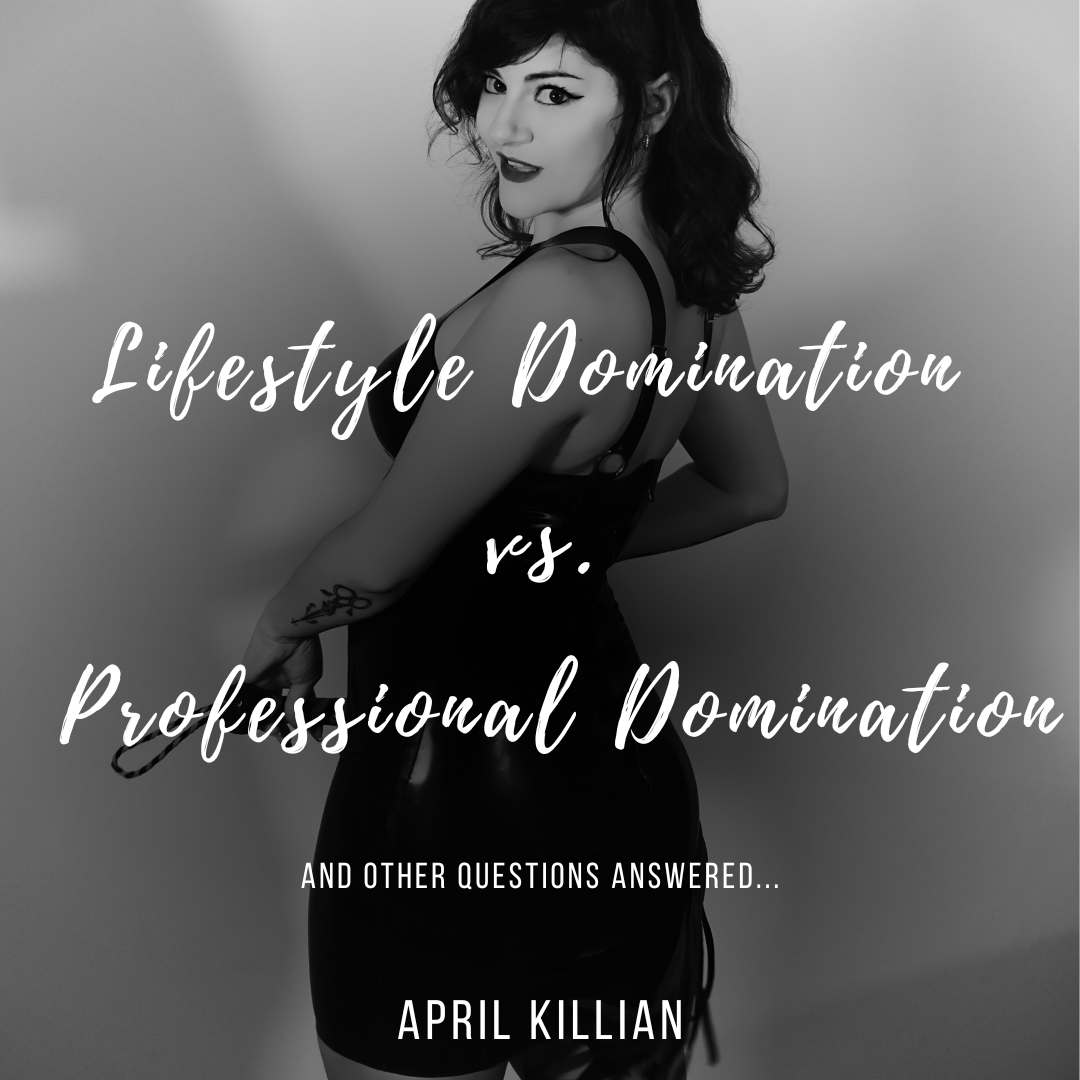
Lifestyle Domination vs. Professional Domination - And other questions answered
Similar Skills, Different Relationships
People often assume that every Dominant does this 24/7 and wants to be showered with money, gifts and continuous devotion. In reality, multiple types of domination skills, purposes and emotional investments exist. Neither is inherently better. They simply serve different needs.
What Is Lifestyle Domination?
Lifestyle domination refers to BDSM dynamics that exist as part of someone's personal life and relationships rather than strictly in a scene.
The relationship itself is usually the goal. Lifestyle Domination demands time, acts of service, availability and devotion as a love language.
It might involve: long-term D/s relationships, 24/7 power exchanges, ownership dynamics, service-oriented relationships, romantic partnerships, poly dynamics, casual play partners, online dynamics without financial exchange,
A lifestyle Dominant usually chooses submissives because of personal compatibility, chemistry, trust, and shared desires rather than because domination is their occupation and their source of income. The emotional ongoing relationship often becomes just as important as the kink itself. A Lifestyle dominant is usually seeking for someone who naturally fits “their style of domination” The submissive enters “their World”. That doesn't mean the submissive's needs don't matter. Healthy lifestyle dynamics are collaborative, and both partners' limits, desires, and well-being are important. But the dynamic tends to evolve around the authentic personalities of the people involved, rather than around a predefined fantasy.
Some poeple use the term more broadly to describe anyone who practices BDSM outside of a professional context. Like many community labels, there isn't universal agreement, and individuals often choose the terms that best reflect their own experiences.
What Is Professional Domination?
Professional domination is someone who practices domination professionally and is compensated for their time, expertise, emotional labour, and specialized skills. It is a service. ( ProDom)
A client hires a Dominatrix to create, facilitate, or guide experiences that satisfy specific fantasies, emotional needs, curiosities, or therapeutic forms of exploration within negotiated boundaries. The relationship exists because both people agree to a professional exchange.
A Pro Dom starts from a different perspective : What experience has my submissive client come here hoping to have? She then evaluates whether that fantasy aligns with her skills, interests, ethics, and limits. If it does, she crafts a safe, negotiated experience around it. The client is paying for her expertise in bringing that fantasy to life, not for unlimited access.
The Dominatrix provides: expertise, often provides a play space, emotional labour, preparation, risk management, creativity, confidentiality, specialized equipment, years of knowledge.
The client compensates her for that work. The financial exchange isn't buying consent. It is paying for time, expertise, emotional labour, and a carefully managed experience.
The Biggest Difference
Lifestyle domination asks: "Can we build an ongoing power dynamic relationship together?"
Professional domination asks: "Can I safely guide you through an experience in this time frame?"
Those questions create entirely different expectations. The biggest difference, in my opinion, is that a pro session is intentionally designed around the clients goals within a doms boundaries.
The Role of Money
This is where people become confused. Lifestyle dynamics may involve gifts, shared finances, financial domination, or service. Some submissives voluntarily support their Dominants because giving brings them joy. But those contributions exist inside an already established relationship. Professional domination starts with a negotiated financial exchange. It is how the Dominatrix earns her living.
Just as a massage therapist is paid for professional expertise, a Dominatrix is compensated for creating a highly specialized experience.
Life style domination scenes and dungeons can often be built over years of submissive investments towards their dom, built over time inside the relationship. Pro Doms tend to purchase everything upfront, and/or rent professional spaces. Pro Doms also pay for the everyday maintenance of said investments: disinfecting supplies, wardrobe, taxes, marketing, studio rents. Clients aren’t expected to slowly “build her dungeon” (although gifts are always appreciated).
Tributes before meetings
It is common for both Lifestyle and Pro doms to ask for tributes before answering questions and inquiries. The fact is that many Doms receive dozens, hundreds, of messages ranging from thoughtful inquiries to fantasy commenters, people who disappear after a few messages. The tribute is often just to demonstrate seriousness. It also forces the submissive to do their “homework” and research if this specific dom is the right one for them before starting to invest in the relationship. It says your time has value. Lifestyle doms can ignore messages. Pro Doms have to spend a part of their workdays sorting genuine clients from fantasy texters.
Financial Domination Is Not the Same Thing
Many newcomers believe every professional Dominatrix is a financial Dominatrix. They're completely different concepts. Financial domination (Findom) is a fetish where the act of giving money is itself part of the power exchange. Professional domination may include Findom.Or it may never involve it at all. Many professional sessions contain no financial domination beyond the agreed session fee.
Different Emotional Needs
Lifestyle submission often fulfills needs like: belonging, partnership, ongoing guidance, identity, devotion, shared growth
Professional domination often fulfills different needs: exploration, fantasy realization, stress relief, emotional catharsis, controlled vulnerability, trying interests safely before entering the lifestyle, experiencing dynamics that may not fit someone's everyday relationships
Many clients already have loving partners. Some are single. Some are experienced submissives. Some simply want a space where they can let go without needing to maintain an ongoing dynamic afterward.
In a professional session, the Dominatrix first discusses limits, health concerns, experience, and goals. The scene is intentionally designed around those needs. Everything is negotiated beforehand. Aftercare is still important, but the relationship returns to professional boundaries once the session ends.
Can One Become the Other or Coexist?
Absolutely. I think it's worth saying this isn't uncommon. Some people meet professionally and later develop genuine personal relationships. Some lifestyle Dominants eventually become professionals. But those transitions require careful renegotiation and clear expectations. A Lifestyle Dom may never have clients, and only partake in personal relationships. A ProDom might have clients on the regular and have a few subs on the side that support other needs. Some ProDoms don’t practice BDSM privately at all as well.
I think emphasizing the boundaries is important. "My submissive at home" and "my client who i see every few weeks" are different relationships with different expectations.
Which One Is Right for You?
Why would someone see a Professional Dominatrix if they could just find a lifestyle Dominant? That depends on what you're seeking. If you're looking for a deep, evolving relationship built around power exchange, lifestyle domination may be what you want. If you're curious about BDSM, want to explore fantasies safely, need an experienced guide, or simply enjoy occasional sessions without wanting a full-time dynamic, professional domination may be a better fit. Neither path is more "real." Both require communication, consent, trust, and mutual respect. If someone enjoys being tied up twice a month but otherwise has a vanilla relationship, they are absolutely kinky, but are they living an on-going power exchange dynamic? maybe not. A Prodom might be more what they are looking for. Some people don’t want a relationship. Some people want to explore a fantasy safely before involving a partner.
How does a dominant choose a submissive ?
I think this is one of the biggest differences.
A Pro Dom is generally asking: Can I provide the experience you're looking for?
A lifestyle Dominant is asking: Do I actually want this person in my life?
Compatibility becomes much more important.
A lifestyle Dominant might reject someone simply because: they don't click, personalities don't match, incompatible communication styles, different values, the submission or submissive’s preferences doesn't naturally inspire anything in them, or they don't have experience or training in those specific preferences. They're building a relationship, not scheduling an appointment.
Will a professional Dominatrix actually care about me?
I LOVE this question. A good Pro Dom does care about her clients.
She remembers: injuries, anxieties, favorite toys, progress, limits, fears.
She wants the submissive to feel safe ( and sometimes a little bit in danger…)
The same way a lifestyle dom would, she wants them fulfilled. She wants them to leave happier and feeling valued. That's genuine care. But...It isn't necessarily romantic love or a personal relationship. I actually like the comparison to a therapist. Your therapist probably cares whether you're okay. That doesn't mean they're your best friend. Professional care is still real care.
Is it normal or awkward to cry during a session or after a session?
It’s absolutely normal to cry. Sometimes intense scenes can release stress that’s been stored for years. Sometimes a session is about fighting a trauma. Stress doesn’t always mean sadness. It can be relief, trust, overwhelm, joy, catharsis, pride, touch, intimacy, vulnerability. It can be a big drop of adrenaline or a raise of tension. Lifestyle scenes and professional sessions can both produce this.
Other Thoughts
Perhaps the biggest misconception is thinking that one is authentic while the other is performative? In reality, both involve genuine skill, negotiation, and emotional intelligence. A professional Dominatrix isn't pretending to dominate any more than a therapist is pretending to listen or a martial arts instructor is pretending to teach. She is using her expertise in a professional context.
Lifestyle and professional domination simply answer different human needs. One is centered on building a personal power-exchange relationship; the other is centered on creating a consensual, intentional experience within clearly defined professional boundaries and time frames.
Where I Stand in All of This
To be transparent about my own position within these definitions, I exist in a hybrid space between professional and lifestyle domination.
I am a professional Dominatrix with over a decade of experience in BDSM and sex work, supported by ongoing training, workshops, and mentorship from practitioners around the world. I actively practice and refine my craft on a weekly basis through structured sessions, often exceeding 10 hours of focused domination work. Alongside my professional work, I also maintain a smaller exclusive personal network of submissives in a lifestyle context. These relationships are based on ongoing dynamics, service, and mutual understanding, where different forms of devotion, structure, or tasks may be exchanged depending on the agreement.
However, I intentionally separate these worlds.My play time and structured BDSM scenes are primarily reserved for professional sessions, where expectations, consent, and compensation are clearly defined. In some specific lifestyle arrangements, negotiated exchanges may include structured tasks, service, or commitments in return for pre-agreed time or play, but these exist within clear boundaries that are distinct from my professional bookings. Within this structure, I also offer limited lifestyle openings through my website. These are not casual arrangements and require an application process. A minimum 2-hour in-person dinner (400$) is required as an initial step to meet, discuss expectations, and assess chemistry before any dynamic is considered further.
For me, the distinction is not about hierarchy or legitimacy. It is about clarity, consent, and intention. Each dynamic serves a different purpose, and I move between them consciously rather than blending them into a single undefined role.


